
Home >> Latest ECRF Blog Articles >> Balancing a Career in District Nursing, Delivering Palliative Care and Completing Research
Balancing a Career in District Nursing, Delivering Palliative Care and Completing Research
Author: Mrs Maria Betts
Published: June 2026
Keywords: Nurse, Research, Caregivers, Patients, Palliative Care Keyworker, Advanced Practice
Throughout my nursing carer, I have developed a professional curiosity for knowledge and ways to improve healthcare for people and their families. I am now working as an Advanced Nurse Practitioner in District Nursing, following completion of a 2-year Masters in Advanced Practice programme. In my previous role as a District Nurse, I was responsible for managing a large caseload of patients alongside managing a team of Community Nurses and Senior Healthcare Assistants. This role was based in the community setting, delivering care to those who are housebound or who live in residential care homes. I found this a rewarding role, though it was not without its challenges, such as staffing shortages and the increasing complexity of healthcare needs of patients on the caseload.
One responsibility of the District Nurse is carrying out the Palliative Care Keyworker (Palliative Care Keyworker) role and function. I have a passion for delivering palliative and end-of-life care and aim to provide a seamless palliative care journey for people and their families, caregivers and those close to them. At times, it felt like there were not enough hours in the day to be able to give people with palliative and end-of-life care needs and their families, the time they deserve. With a focus on the palliative care journey, I aim to deliver holistic person and family-centred care by identifying what a person’s physical, psychological, social and spiritual needs are. It is ultimately about what matters most to the person to ensure respect, engagement and collaboration to support their right to determine their own destiny.
My role as an Advanced Nurse Practitioner in District Nursing is to support District Nursing teams to deliver high quality person-centred care to the people in our community. We only get one opportunity to get it right, therefore it is about having those courageous conversations regarding Advanced Care Planning (ACP), which is essential to support people to live and die well at home. The process focusses on individual wishes, preferences, values and goals for their future. I feel that as an Advanced Nurse Practitioner in District Nursing, I am often well-placed to initiate these conversations and support the District Nurse to continue to document the evolving discussion. I feel strongly that people who wish to die at home are supported to do so. People are autonomous in their own home and are surrounded by their loved ones in their own familiar setting. Supporting people to remain at home may include the education and training of family caregivers. These unpaid caregivers are the extension of our workforce and provide much of the care for their loved one. This was the basis of some of the research that I have undertaken.
It was through my work as a District Nurse that I experienced verbal feedback from patients and staff about how they felt about the Palliative Care Keyworker role. This feedback was mixed and on having looked for literature and guidance on the role, found that there was very little support for it. Families would report that they did not know that there was such a thing as a Palliative Care Keyworker. They knew the District Nurse managed many aspects of their care but not that they were the single point of contact to ensure people and their families knew who to contact in relation to their healthcare needs. A resource was required to support the identification of the Palliative Care Keyworker, this was developed as a booklet for people and their families with information on the role and what they can expect. I felt that research was required on the role of the Palliative Care Keyworker and what impact it has on people and their families which guided the direction I wanted to take my research.
As I had studied at a level 7 during my Specialist Practice Qualification in District Nursing, I decided to complete my Masters studies through completion of a thesis. I undertook a scoping review of existing published literature, examining the role and responsibilities of the Palliative Care Keyworker. This gave me the foundation of what the role looked like in other parts of the world and that in many areas it did not exist at all. This was a challenging year for me as I had just started my new role as a District Nurse in Nov 2019. I had self-funded the programme and was using my annual leave and spare time to complete. The thesis did not start out as a scoping review, with the impact of the Covid-19 pandemic escalating in March 2020, changing the whole dynamics of interviews. Online meetings/video calls were not a usual part of my role, nor was I aware of how to use the technology. I was grateful to my research supervisor, Dr Felicity Hasson, for her support throughout this time as she was not only an educator but also someone who truly cared for my well-being. I was delighted to be able to submit my thesis and publish the paper in 2022. As for all of us, I found the Covid-19 pandemic to be overwhelming. Initially, statistics were only gathered for those who died from Covid-19 form the hospital setting. My Covid-19 journey felt different. People were diagnosed and treated in the community. Some did not wish to go to hospital, therefore required palliative and end-of-life care in their own homes and residential homes. This gave me greater insight into how discussing Advanced Care Planning early is so important to ensure people’s wishes are respected and captured at a time when they are able to make these individualised decisions about their future care.
As the Advanced Practice Programme had a large element of research, I decided to further my research of the Palliative Care Keyworker. This time I interviewed caregivers who either currently or had looked after a loved one with Motor Neurone Disease (MND). There was no published literature which explored family caregivers’ views of the Palliative Care Keyworker role. Family caregivers are a vital group as they really are the unpaid ‘backbone’ of our health service and their voices are often left unheard. I felt I needed to explore this area so that I could inform policy and education, improving care provided to people with MND and their family caregivers. As I was interviewing family caregivers, some of whom were bereaved, I had to be mindful of caring or other commitments they had. I undertook most interviews in the evening via video call. I honestly felt emotionally exhausted carrying out these interviews. The rawness of the feedback from caregivers was overwhelming, both positive and negative. I felt honoured that they were willing to speak with me. I discussed the content of the interviews and how they made me feel with my supervisor who supported me throughout the whole process. Thematic analysis was used to code the interviews which involved me listening to and transcribing the data at length. It gave me a new perspective on how a life-limiting illness can impact family caregivers, the support that is often lacking and what research needs completed in the future. The findings from this research have been accepted and will be published in the International Journal of Palliative Nursing in due course. I found this research challenging alongside my home life as I spent a lot of evenings completing interviews, transcribing and analysing data and documenting the study, meaning there was less time for my children. I tried to balance work, study and home life as best I could but it was not without its challenges.
I feel that I am a more compassionate practitioner. I don’t just ‘listen’ to people and their families but I hear what they are ‘telling me’. Since I published my paper examining the role of the Palliative Care Keyworker, several other nurses have completed research in this area, continuing the emphasis the value of the Palliative Care Keyworker role has. I hope that the research that I have completed will not go unnoticed and it will resonate with policymakers to consider and appreciate unpaid family caregivers as an essential part of the palliative care journey.
References:
Hasson, F., Betts, M., Shannon, C. and Fee, A. (2022) Roles and responsibilities of the community palliative care keyworker: a scoping review. British Journal of Community Nursing, 27(8), 384-391.
Meet the author:
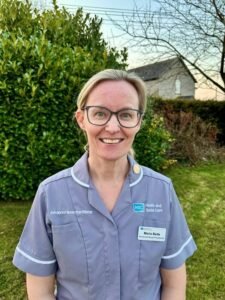
Maria has been a registered nurse for 22 years with 18 of those working in the community setting. She has a Masters in Nursing and is a non-medical prescriber. She also has a Masters in Advanced Nursing Practice. Maria currently works full time as an Advanced Nurse Practitioner in district nursing. Maria supports district nursing teams to deliver high quality, person-centred care. Maria has extensive experience of working with people with long-term conditions and palliative care/end of life care needs in their own homes/care homes. Maria has a keen interest in palliative care and frailty. She has published 3 papers regarding these areas.
Maria holds the accolade of Queen’s Nurse. She is part of a unique network of nurses working to improve practice with evidence-based care in the community. She is also a Florence Nightingale Scholar. Maria was also runner up in the RCN NI Nurse of the Year awards 2025 (research award).