
Investigating the Supportive Care Needs of People with Dementia Living with a Cancer Diagnosis and Their Caregivers
Dementia, Cancer, Caregivers, Supportive Care, Comorbidity
As people are living longer, more individuals are being diagnosed with both cancer and dementia. However, their supportive care needs remain unclear, resulting in care that often overlooks the complexities of managing cancer and dementia together. Research suggests that people living with both conditions experience poorer outcomes than those with cancer alone, including later diagnosis and higher mortality, despite higher levels of engagement with healthcare services. Symptoms of dementia, such as changes in memory, behaviour, and communication, are often not fully considered during cancer care. Services are typically designed to treat cancer and dementia separately, which can lead to fragmented and unsuitable care. As a result, people often rely heavily on informal caregivers for practical, emotional, and informational support, yet caregivers frequently receive little guidance when navigating complex treatment decisions.
Addressing this gap is essential to ensure that care is coordinated, appropriate, and responsive to the needs of people living with both cancer and dementia and those who support them.
This study aims to investigate supportive care needs of people living with both cancer and dementia and their caregivers. Supportive care needs include psychological, physical, emotional, practical, spiritual, informational, and social needs. By identifying these needs and gaps in care, the project hopes to highlight ways services can better support these populations.
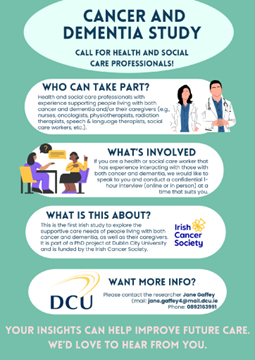
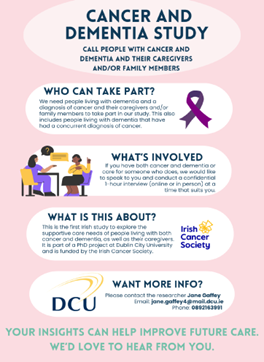
Phase 1 of this research consisted of a systematic review investigating the supportive care needs of people with cancer and dementia and their caregivers. Phase 2 of this research involves interviews with people with cancer and dementia, their caregivers and relevant health and social care professionals, to hear their experiences firsthand. All methods follow strict ethical guidelines to ensure participants’ privacy and comfort.
Public and patient involvement has been embedded throughout this project. Two PPI collaborators with lived experience have contributed to shaping the research, including reviewing findings from the first phase of the study and helping to identify key areas of importance.
They have also supported the development of study materials, including interview guides and participant information sheets, to ensure that the language is clear, sensitive, and accessible. Their input has helped to ensure that the research focuses on issues that matter most to people affected by cancer and dementia.
PPI will continue throughout the project. Collaborators will be involved in interpreting findings, ensuring that results reflect real-world experiences, and supporting the development of accessible summaries for wider public and patient audiences.
This ongoing involvement helps to ensure that the research remains relevant, respectful, and grounded in lived experience.
Phase 1 of this research involved a systematic review that brought together evidence on the supportive care needs of people living with both cancer and dementia and their caregivers. The review found that people living with both cancer and dementia have a wide range of care needs spanning psychological, practical, physical, informational, and emotional areas. For example, people with both conditions expressed needs for dementia-inclusive care that takes cognitive symptoms into account, tailored communication from health professionals, continuity of care, and treatment plans that are suitable for their individual circumstances. Caregivers similarly identified needs for clear, cancer-dementia-specific information and effective coping strategies. Barriers to meeting these needs included lack of dementia training for healthcare staff, unsuitable treatment planning, and limited resources specific to this comorbidity, while facilitators included person-centred approaches and multidisciplinary teamwork.
These findings identify the supportive care needs experienced by people with cancer and dementia and point to important gaps in existing services, including the need for more integrated, dementia-aware cancer care and caregiver support.
Building on this work in Phase 1 Phase 2 will generate new primary data to better understand lived experiences and inform the design of services and supports that reflect the needs of both people living with both cancer and dementia and their caregivers.
October 2023 – October 2027
PhD Candidate:

Jane Gaffey, School of Psychology, Dublin City University
Principal Investigators:

Dr. Simon Dunne, School of Psychology, Dublin City University

Dr. Louise Hooper, School of Psychology, Dublin City University
This PhD project is funded by the Irish Cancer Society’s Survivorship Scholarship.

Our research has highlighted the unique supportive care needs of people living with both cancer and dementia and their caregivers.
Phase 1 findings were published in the Journal of Cancer Survivorship https://link.springer.com/content/pdf/10.1007/s11764-025-01945-8.pdf and shared at national and international conferences (i.e. Alzheimer Europe, IPSON, Engaging Dementia Conference).
Furthermore, Jane Gaffey was a finalist in both DCU’s Tell it Straight Competition (2025) and the Irish Cancer Society’s Research Awards (2025) and was the recipient of the PPI Ignite National PhD Excellence Award (2026) for excellence in Public and Patient Involvement in Doctoral Research.
Jane Gaffey also published an article with RTE Brainstorm titled “How do we provide care for people with both cancer and dementia?” https://www.rte.ie/brainstorm/2025/1218/1547297-caring-for-people-with-cancer-dementia/
We’ve also engaged the public through media and social campaigns, raising awareness of cancer-dementia challenges. Ongoing work will provide new insights to guide healthcare practice and improve support for both people with cancer-dementia and their caregivers.
Members of the research team have conducted prior work that highlights gaps in supportive care for people living with cancer and complex health needs.
One study, co-authored by the current researcher (Byrne et al., 2023), was a systematic review exploring body image concerns in people with cancer-related lymphoedema. The review found that body image is an important part of well-being but is often overlooked in cancer care. Factors such as physical changes, pain, and altered appearance were linked to increased body image concerns, and targeted interventions had positive effects. The study emphasises the importance of screening and tailored support to improve patient well-being.
Another study, co-authored by the project supervisor (Cochrane et al., 2023), systematically examined the relationship between quality of life and unmet supportive care needs in people with lung cancer. The review found that unmet physical and psychological care needs were strongly associated with poorer quality of life, especially for patients with advanced cancer. These findings highlight how gaps in supportive care can directly affect well-being and point to the need for services that address the full range of patient needs across the disease trajectory.
Together, these publications provide strong evidence that people with complex cancer-related health challenges may face unmet supportive care needs, underscoring the importance of research specifically focused on people living with both cancer and dementia.
Jane Gaffey|Email: jane.gaffey4@mail.dcu.ie|
Instagram: cancerdementiaphd|
Facebook:
PhD Project: Cancer-Dementia Caregivers – https://www.facebook.com/profile.php?id=100092138300253
Dr. Simon Dunne | Email: simon.dunne@dcu.ie
Dr. Louise Hopper | Email: louise.hopper@dcu.ie