Meaning-centered Psychotherapy for Palliative Care Outpatients; an Innovation in Clinical Practice
Authors: Rory Cousins, OLH with Dr Niall Galligan, OLH and Dr Deirdre Murphy, OLH
Published: July 2024
Keywords: Existential Psychotherapy; Group Intervention; Clinical Psychology; Clinical Innovation; Outpatients
What is Meaning-centered Psychotherapy?
Meaning-centered psychotherapy is a group intervention designed to alleviate psychological distress among hospital outpatients with advanced cancer.1 The programme focuses on sustaining patients’ sense of meaning and purpose as they approach end-of-life. The intervention is borne out of the idea that enhanced meaning likely reduces one’s risk of severe depression, hopelessness, and desire for hastened death at end-of-life.2 In recent years, adapted versions of the intervention have been developed for ‘one-to-one’ bedside delivery with palliative care inpatients.3 However, the feasibility of delivering group-based meaning-centered psychotherapy in a palliative care outpatient setting (e.g., patients that are more ambulatory and have longer prognosis) remains relatively unexplored.
And what’s the difference between an ‘’outpatient’’ and an ‘’inpatient’’?
An outpatient is a patient that currently receives care in the community (e.g., at home) or attends the hospice for a scheduled day appointment. In other words, after attending their appointment, an outpatient returns to their home residence. In contrast, an inpatient is a patient that receives care and stays overnight in the hospice. The support needs of an inpatient are generally higher than those of an outpatient.
Historical origins of meaning-centered psychotherapy – the life and work of Viktor Frankl
Meaning-centered psychotherapy was developed as an extension of Viktor Frankl’s logotherapy. Logotherapy (for more information see; https://viktorfranklamerica.com/what-is-logotherapy/) is a therapeutic approach that focuses on helping people find meaning and purpose in life. Viktor (an eminent Austrian psychiatrist) was interned in four different concentration camps beginning in 1942 during which time he lost many of his immediate friends and family. In essence, every human freedom was taken from Viktor – a dehumanising experience he recounts eloquently in his international bestseller Man’s Search for Meaning. Rather than surrendering to the harshness of his situation, Viktor realised that despite the limitations imposed on his freedom, dignity and will; there remained one final freedom that could not be taken from him, his freedom to choose the attitude he adopted toward his given circumstance.
“The last of the human freedoms: to choose one’s attitude in any given set of circumstances, to choose one’s own way. And there were always choices to make. Every day, every hour, offered the opportunity to make a decision, a decision which determined whether you would or would not submit to those powers which threatened to rob you of your very self, your inner freedom; which determined whether or not you become the plaything to circumstance, renouncing freedom and dignity…”
“When we are no longer able to change a situation, we are challenged to change ourselves.” – Viktor Frankl
Why implement a group programme rather than ‘one-to-one’?
Group interventions offer an opportunity for members to share their experience of life-limiting illness with others which can in and of itself be an opportunity for therapeutic growth. Additionally, group delivery of meaning- centered psychotherapy is intended to meet the growing demand for psychology services among patients in outpatient contexts.
The evidence-base for meaning-centered psychotherapy in outpatient oncology services is well documented. However, meaning-centered psychotherapy has only been evaluated among patients in inpatient palliative care settings. Therefore, as an innovation in clinical practice, we want to address this gap in research and explore the efficacy and feasibility of this programme for patients in outpatient palliative care settings.
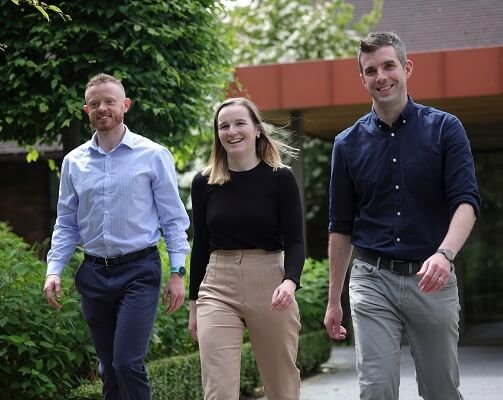
The therapy room used to deliver the meaning-centered group intervention.The Psychology team in Our Lady’s Hospice and Care Services (L – R); Rory Cousins, Dr Deirdre Murphy & Dr Niall Galligan
Have we any plans for the future?
Yes! In the not-too-distant future, we hope to design, deliver and disseminate a mixed methods research evaluation of meaning-centered psychotherapy. A mixed-methods research study involves collecting quantitative (e.g., information in the form of numbers) and qualitative (e.g., information in the form of words/opinions) data from participants. The design of our future study will incorporate this feedback provided by the patients that took part in our initial group.
This future research project will focus on exploring the efficacy and feasibility of meaning-centered psychotherapy for individuals accessing palliative care outpatient services.
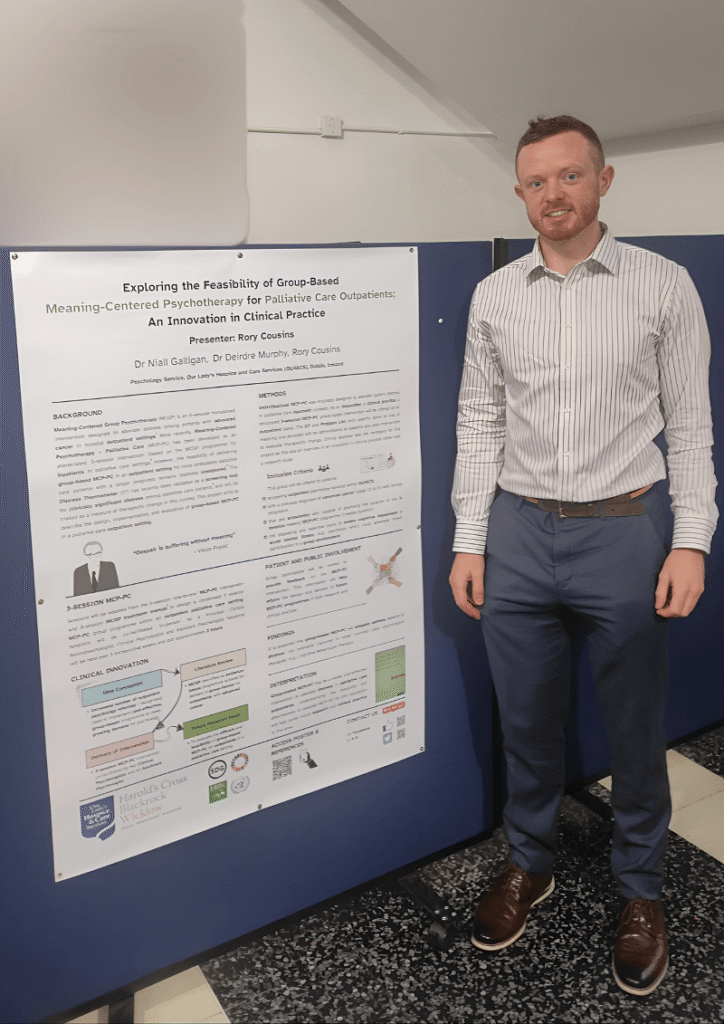
Rory Cousins presenting our meaning-centered psychotherapy poster at the PCRFNI Palliative Care and Psychiatry Conference 2024 hosted in Queens University Belfast.
References
[1] Breitbart, W., Rosenfeld, B., Gibson, C., Pessin, H., Poppito, S., Nelson, C., … & Olden, M. (2010). Meaning‐centered group psychotherapy for patients with advanced cancer: a pilot randomized controlled trial. Psycho‐oncology, 19(1), 21-28. https://doi.org/10.1002/pon.1556
[2] Breitbart, W., Rosenfeld, B., Pessin, H., Kaim, M., Funesti-Esch, J., Galietta, M., … & Brescia, R. (2000). Depression, hopelessness, and desire for hastened death in terminally ill patients with cancer. Jama, 284(22), 2907-2911. doi:10.1001/jama.284.22.2907
[3] Rosenfeld, B., Saracino, R., Tobias, K., Masterson, M., Pessin, H., Applebaum, A., … & Breitbart, W. (2017). Adapting meaning-centered psychotherapy for the palliative care setting: results of a pilot study. Palliative medicine, 31(2), 140-146. https://doi.org/10.1177/0269216316651570
Meet the author
Rory Cousins is an Assistant Psychologist working in Our Lady’s Hospice and Care Services. Rory is interested in the implementation and evaluation of psychological interventions to alleviate patient distress at end of life. Additionally, Rory is interested in supporting the continued development of psychology services within specialist palliative care. Rory is a proud member of the AIIHPC Early Career Researcher Forum and recently presented at the PCRFNI Palliative Care and Psychiatry Conference 2024 hosted in Queens University Belfast. Rory would like to acknowledge the support of the co-authors of this submission: Dr Niall Galligan, Principal Clinical Neuropsychologist, Our Lady’s Hospice and Care Services
Dr Deirdre Murphy, Clinical Psychologist, Our Lady’s Hospice and Care Services